
The life and work of Thomas Cranmer, Archbishop of Canterbury under Henry VIII and unparalleled reformer of the English church, was the subject of our enlightening and fruitful seminar led by Adam Curtis, with a particular focus on the Collects that Cranmer wrote for the Book of Common Prayer (1549 and 1552). As Adam explained, whilst Cranmer was a giant of the English Reformation, he seems both a reluctant and flawed hero; on seeing Ridley and Latimer burned in Oxford, he signed documents to recant his Protestant views. Yet before his own execution, he recanted his recantation, indeed he ‘put his right hand into the flame, which he held so steadfast and immovable’, since ‘forasmuch as my hand offended, writing contrary to my heart, my hand shall first be punished therefore; for when I come to the fire it shall be first burned’. Cranmer’s deadly persecution of both Anabaptists and Catholics makes it hard for us to see him in this very different age as quite as much the martyr as Foxe was keen to paint him. 
Cranmer’s prayer book was not a wholesale rejection of the ancient Latin text in universal use throughout sixteenth-century England but rather a book that retained all that was scripturally sound whilst replacing or modifying that which was degenerate (often in quite subtle ways). And, crucially for an Archbishop who ordained that ‘men must speak in the congregation in such tongue as the people understandeth’, his prayer book was in English. As we learnt, Cranmer’s legacy to the Church of England was profound.
As we worked through a number of Cranmer’s Collects, the conciseness and elegance of these scripture-fuelled prayers was most apparent to us. I must confess that, with a few exceptions, I have largely overlooked the Collects in the past, partly finding them quite terse or hard to follow, and partly not entirely understanding their purpose within a service. Adam’s explanation of the structure and content of the Collects has greatly increased my understanding of the meaning and purpose of the Collects.
As for content, Adam asked us to examine one Collect and identify no fewer than six biblical references in one very short prayer. Whilst one Collect might superficially resemble its Latin parent, Cranmer used small changes to pack in yet more scripture. A single Collect can remind us of so many of God’s attributes and promises within very few words.
I found learning about the structure was particularly revealing. Cranmer’s Collects necessarily divide neatly into three sections: an address, a request and the basis on which we ask. We considered three different Collects and broke them down into these sections. On doing this I found the meaning leapt from the page.
The starting point for full understanding is probably the middle, that is, the request. Each request is one thing that we are asking of God, for example, ‘Grant that we may … hear (holy scriptures), read, mark, learn and inwardly digest them’, together with a purpose, ‘that … we may embrace, and ever hold fast the blessed hope of everlasting life’.
The address is more than merely naming God, yet it is no ‘prayer padding’. God is addressed reverently, but in a way that relates to the request: ‘…who hast caused all holy Scriptures to be written for our learning’. Similarly, the Collect ends with the basis on which we ask – that is through the mediation of Jesus Christ, but, in many cases, relating to the purpose within the request: ‘…everlasting life, which thou hast given us in our Saviour Jesus Christ’. 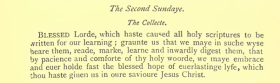
We all had a go at writing our own Collects using this model – the first based on this week’s morning sermon (Luke 12:35-53) and the second based on a characteristic of God. It was not easy! However I found this an enormously rewarding exercise, and something I am keen to continue trying. It is not that writing formal prayers should be our principal way of talking with God, that would seem rather unbiblical. Rather that this can give a particular direction in our Bible reading, both when looking at a theme spanning many books, and when considering just a few verses in great depth and devotion.